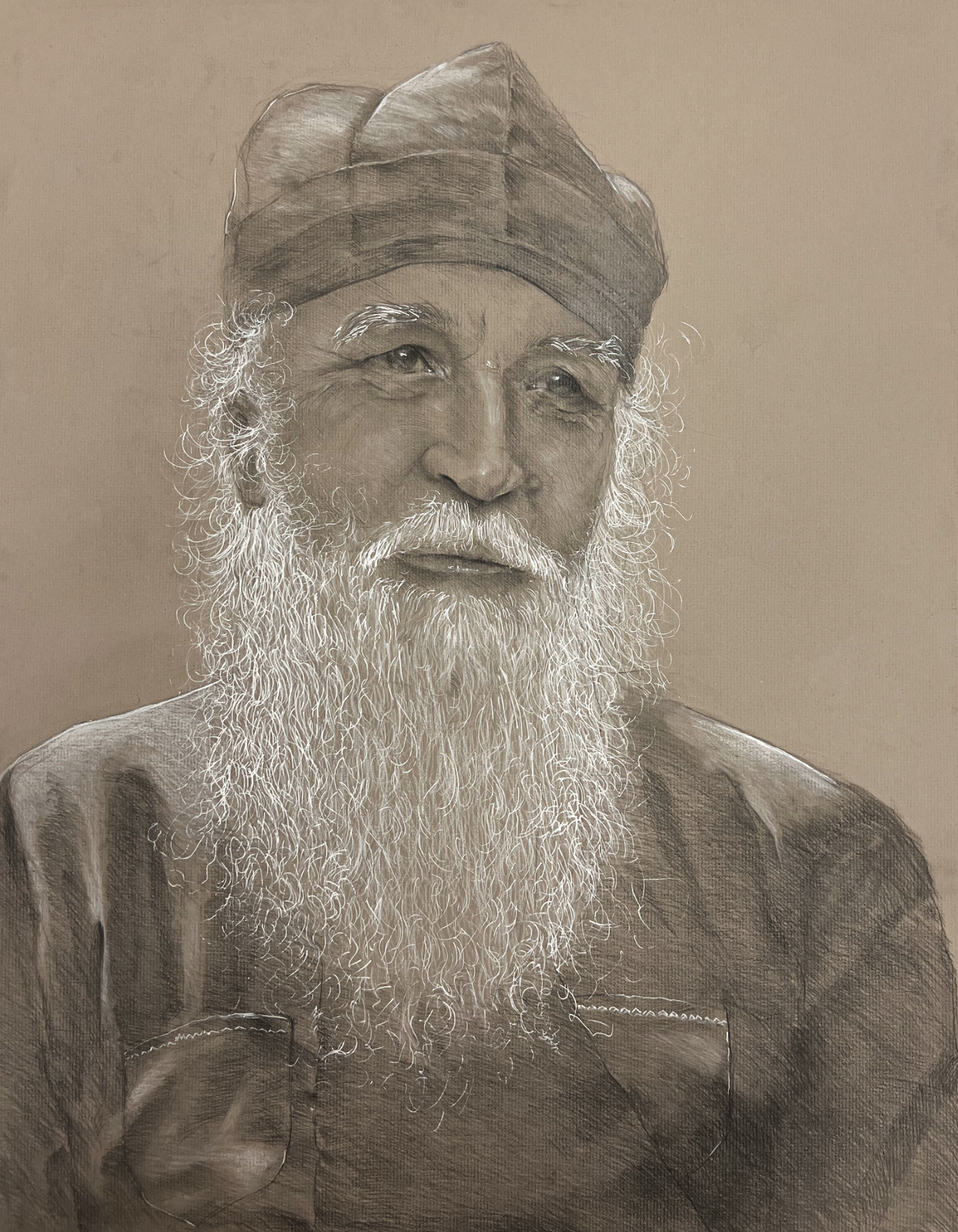
Charcoal and gel pen portrait drawing
by 11th grader Alina Sukhovskaya
Closing Remarks of a Star-Born Soul
By Hamza Mairajuddin
Tomorrow, I will surely be dead.
Of course, I’ve said that before every flight. I said that before my first supersonic flight, before my first edge-of-space flight, before my first lunar flight, and before my flight right here, to Weir Outpost on the equator of Mars.
God, I love my job.
The nature of my job ensures that I hate my job. Every time I take off, I know that if I land, I’m a hero. If I don’t, I’m dead.
Today, I’m either a rocketman or a dead man walking.
Tonight, our mission captain is going to give a speech. We call it “the pre-eulogy.” I’m supposed to give feedback. It’s a stupid tradition. What good does preparing for my death do for the success of my mission? I walk past a window in the long hallways that connect our barracks to the main rooms. I can see the ship, the San Lazaro, being shuttled by rovers to the launch pad beyond the edge of our crater. He’s brand new but already covered in the red dust of Mars. He falls behind the threshold of the window and I keep walking, bounding down the halls with no effort. In a few short steps I’m at the end of the long hallway, in front of the door to the mess hall.
When it slides open, I’m greeted by my crew. All thirteen of them crammed into the canvas-lined, pressurized bubble of our mess. At the front of the room is the Captain. He claps along with the rest as I take my seat. He starts off talking about how I should be dead. Then he reiterates, I should have died, but I didn’t. Not because of dead reckoning, but because I’m a fancy flier with no sense of self preservation. In all our years flying together, he says, he’s always been certain I’m a goner every launch, and after every landing he’s waiting for the next. After his speech, the crew thanks me, gives another hearty round of applause, and then goes back to their barracks.
Thanks, Captain.
Sunset is different on Mars. The dust skews the light to a soft glow from the horizon. It’s beautiful. We launch tomorrow morning. It’s easier for us to launch in the morning. The lower temperatures and clearer visibility make the calculus easier. It’s far from a straight shot from that launchpad to Phobos.
Before each launch, I do a check on my ships. It’s pure superstition, I know. There’s a person who has a degree in making sure I’m safe before launch that does four rounds of checks each time. But my check is personal.
It’s not a check to see if the ship can get off the ground; It’s a check to see if we can go further beyond.
I’m standing in the airlock now, climbing into a weighty suit. They’ve tried for years to make them lighter but the only thing going for that is the lack of gravity here.
With a click my helmet locks in place. I flip my visor down and slam the depressurize button. Pumps, humming, groaning, a myriad of sounds come from the airlock until they subside and a soft but artificial voice sounds in my ear.
Five hours of oxygen remaining.
I bound up the hillside on the trail we dug out and lined with lights. I see soft glints from San Lazaro on the edge of the crater and soon I’m standing right in front of him. His lines swoop from the boosters to the cockpit. Huge delta wings droop forward on his mount, which has him angled upwards towards the stars. I pull open the door on the temporary airlock around his hatch. Pressurization and I’m in the main cabin. I flip up my visor to survey the room. Science equipment, rations, water, shelter. Everything for Operation Lazarus’s stage 1. Tomorrow, I’ll dump this on the surface of Phobos and fly back. It’s a proof of concept. A proof that a ship like San Lazaro can make the trip.
And it’s a damn cool story to tell when I get back.
I step again through a pressurized door, this one leading into the cockpit. I settle into the pilot’s seat and run my hands over the controls. Part of my training was memorizing where every button was on the control panel. I should be able to do anything and everything without ever having to take my eyes off my center display and, of course, the vast nothingness of space.
I flip my visor back down and am on and make my way back to base. When I get to the very edge of the crater, I look up. We’re at that point in Mars’s orbit where we can see the Earth as a faint speck in the night sky. I pull down my HUD and it points out a specific dot. It labels it “Earth: Mission Origin”. Just next to it is another circle, nothing big enough to see inside it. It’s labeled USF Noah, and it’s given a time of arrival. Underneath, an identifier in the Lazarus Series Red: “Project Chariot.” The settlers for the base I’ll set up tomorrow on the surface of Phobos. The first lunar settlement on a moon other than Earth’s in human history. Research on everything from new life to better reaction wheels for rocket maneuvering.
Billions of dollars in taxpayer money, the lives and time of a crew of five astronauts and one dog, the viability of the Lazarus Program, all rests on me being able to get that bird off the ground and onto a tiny little dot in the vast nothingness.
No pressure, I guess.
I take one final look at the stars before I descend into the crater.
The next morning, I’m up before the rest of the crew— I did not sleep. I’m anxiously pacing in the airlock for hours before the Captain finally opens the door behind me. He asks me how long I’ve been waiting for him. I tell him I don’t remember when I arrived. He tells me he’s got faith in me. I tell him that’s the only thing that keeps landing my ships safely. He laughs, claps me on the shoulder and gives me a light hug. We both suit up and make our way out of the airlock. He begins giving me my final mission rundown. All systems are fully operational, he says. Ground Control (back on Earth) had handed over all control to Ground Control (here on Weir Outpost), and everyone back at base is doing whatever they can to make sure what goes up comes back down softly. The only concern anyone had was of a small sandstorm on the horizon. But, if everything went to plan, I’d be out of the atmosphere before it arrived.
When we crest the crater’s lip I see it. The sandstorm is just a faint smudge on the horizon behind San Lazaro. The ship is dirtier than last night. The Captain tells me it was remnants from a stronger storm last night, but that nothing should be damaged. He’d check just in case. He steps in front of the San Lazaro and gives me a thumbs up and a salute after his checks. His voice crackles over the comms with a wish of luck.
Just twelve hours prior I was in the cockpit of San Lazaro, and now I stepped into the cockpit again for the last time. Regardless of if I died or landed tomorrow morning, I would never have to fly this bird again.
Hallelujah.
One of the specialists’ voices comes over the radio. They ask if the launch site is ready. The Captain and I both confirm we did our preflight checks and are “All systems normal”. I hear a distant confirmation as San Lazaro begins to pitch back on the launch deck, clunks as the launch mechanism locks into place. I look at the camera just in front of the yoke. A thumbs up and a salute is enough for them to initiate the countdown.
At eight the boosters ignite. At five the rail unlocks. At three San Lazaro begins to shake.
At one I’m alive. At takeoff I’m something more.
Then just after San Lazaro leaves the launch rail, I feel like I’m dying.
My accelerometer peaks and holds steady at 4 Gs, which feels like 10 after the weaker gravity of Mars. Even though I was told all systems were good, I’m drawn to a flapping sound coming from the control surfaces on my left wing. If I could move my mouth I would ask if systems were nominal, but shock has taken the words along with the bravado. I slowly remember where I am and begin pulling back on the yoke, minor adjustments to keep me on trajectory. My HUD shows exactly where I should be aiming but San Lazaro’s nose is just below that. The acceleration begins to lessen. I can speak again. I learn, also, that I can hear Ground Control again. They’re telling me to pull harder on the yoke because the control surfaces aren’t as responsive as they’d anticipated. I jerk it back and again am flattened by the acceleration but now San Lazaro and I are on a straight shot to space.
Once aligned, I turn my attention back to my instruments. The rattling on my left wing gets louder the higher we go. Ground Control has no answer but tells me to remain upward bound. So higher San Lazaro and I climb. Higher as the sky turns from musty orange to a deeper purple as the non-light of space filtered through. I push down on the yoke as instructed by the trajectory, rattling on the left wing getting louder, right wing joining in. A blaze ignites where San Lazaro’s nose and underbelly begin to heat the atmosphere. Eventually, the force grows to where we begin to pitch up. The rattling grew louder. I convey this to mission control, who tell me to level out. The rattling turns into groaning and I leap on the yoke. I shove it forward before I hear a snap from my left wing and see a red flashing screen dominate my HUD.
I lost a left wing control surface.
This was expected— by me at least. All it meant was I couldn’t navigate in any substantial atmospheres. Ground Control tries to get me to abort but I tell them I couldn’t. I need to escape the atmosphere before I can pitch back down. So higher I go.
High enough where the purple fizzles out to black and the blaze dies down.
High enough where all I can see is the sleek silver nose of San Lazaro and the stark beauty of the stars.
In typical NASA fashion, at that moment, I run out of non-oxidized fuel and my engines fizzle out. A small message comes up on my HUD notifying me to switch engines from atmospheric to vacuum. I’m too busy taking in the stars.
Just over the horizon a circle is drawn around a drab brown speck. The HUD labels it “Phobos: Mission Destination.” The chevron for the trajectory indicator just above it begins to move downward before turning upside down and pointing at the dusty surface of Mars. I lean the yoke to the right and San Lazaro begins to roll. I pull left just before we’re upside down relative to Mars but he just keeps spinning. I keep pulling left. San Lazaro keeps pulling right. It didn’t make any sense; the left control surface doesn’t have an effect in the vacuum of space.
And then I remember.
Mission control remembers at that instant too that each control surface has a reaction wheel— a weight used to maneuver in zero gravity– and right now I’m unable to use the leftward wheels to counterroll my accelerating rightward spin. My only hope is to burn fuel to get some sort of speed and counterroll with my boosters. My accelerometer begins to climb again. It crosses the 1 G mark as the spin becomes noticeable. Ground Control tells me to stay calm but the only thought going through my mind is “punch it”.
I throw the throttle forward and buckle down in my seat again. Yoke locks left, acceleration rightward peaking at 4 Gs before beginning to come back down. Slowly, San Lazaro begins to calm down. Then the creaking returns.
Just as the accelerometer ticks below 2 G, the left wing begins creaking again and Ground Control is yelling at me to cut the throttle. I yank it back. I’m still spinning. But this time I can hear the right wing’s reaction wheels thrumming through the hull.
They’re speeding up.
So back around San Lazaro and I go. Rightward spin and our G forces up again until I tell Ground Control I have to stop the spin and punch the throttle again, throw the yoke to the left, and hear my left wing groan.
Then, I hear it snap.
At once I’m bombarded by alarms. I had lost my left wing, and along with it I had lost a third of my engines that I’d use for landing, half of my fuel, both left reaction wheels, and any hope I had of completing the mission.
The final message comes up just seconds late. The fuel connection is severed and I need to cut the engines immediately or I risk igniting the fuel leaking from the left wing’s tanks. On its third flash on my HUD, the San Lazaro jerks forward and rattles, spinning in all directions, leaking fuel from the gash on its left wing, engines burning what little fuel was left in its right, and its orbit just high enough to reach Phobos unless I intervened right now.
I scream this over our comms and Ground Control told me that they have identified the computer malfunction and are rectifying it now. I hear a ping over the comms and the whirring in the right reaction wheel stops. Then, it starts up again, this time in the opposite direction. My rightward spin comes to a stop, and San Lazaro’s forward roll is next. Again, I punch the throttle and pull back on the yoke, right reaction wheels doing everything they can to help. Fuel had been 100% when we launched. Now it’s 40% and dropping fast. The hop from orbit to Phobos needs at least 30% of the fuel I took off with. Getting back needed 20%.
San Lazaro’s spin dies down and I see myself reflected in my visor faintly. Mars lies beyond it, the HUD circling it like it did with all other notable bodies in my view.
Mars: Mission Destination. It refreshes; Mars: Mission Origin.
The trajectory chevron reappears in my view. This time pointing down and to the right in a retrograde burn to get me back into Mars’s atmosphere and end the mission. I look as left as I can in San Lazaro’s windows to Phobos. Its label has changed too.
Phobos: Mission Destination – Mission Failure.
“Mission Failure.” Ground Control had already updated it to “Mission Failure.” Not five seconds out from me rescuing the burn and it had already become “Mission Failure.” I begin angling San Lazaro towards the chevron, Mars receding behind me and in front of me, again, the vast nothingness of space. Once I align with the trajectory, I get a readout of metrics the algorithm had predicted for me: Peak Gs were 7, peak hull heat was 1,000 degrees Celsius , estimated time to landing was twenty minutes, and estimated fuel usage was 35% of what San Lazaro was equipped with on takeoff.
That number looks funny, I told mission control. They tell me it’s accurate. I check my fuel readout. I only have 25% fuel left. I tell them that. They tell me to burn all the way through and hope for the best, but I know 25% is just going to trap me in a slowly decaying orbit over the Red Planet. 25% leaves me in a place I’d never thought I’d be stranded in: just above the sky and just below the stars.
I’d run out of oxygen before my orbit slowed enough to crash down on the surface. Any crash without an active burning engine meant certain death for me either way.
My time as Rocketman is over.
But I wasn’t about to let myself be a dead man.
I begin angling us back at Phobos. The turn smoothing out into the prograde trajectory I needed to make it to Phobos’s sphere of influence and set down on its surface. I point straight at the box called failure and hold. The HUD picks up what I mean as a command. I need to know what a trip to Phobos looks like. The HUD gives me nearly the same readout as before– except peak hull temperature is below freezing and fuel needed to get there is almost everything I have left.
Ground Control begins to panic over the comms. They yell in my ear to come back, turn back, burn back– to pray, to hope, to yearn for safety. Eyes locked on Phobos, I turn on the display in the window of our cockpit. The HUD layers over itself until I take off my helmet and am greeted with silence. I nudge the yoke into the center. Throttle punched, we begin to sail through the murky waters of space. Phobos speeds closer as the stars distort around our view. For my entire life, I’ve yearned for the release, for my final flight. I could never picture what life would look like after it except for me sitting on a rock at night and looking at the stars.
I was always just a dead man walking. I was always just the guy that went there and back. I never was the guy that went down in history. I’m fine with that.
I’m still fine with that as Phobos rushes closer. I lose track of time scanning the stars. Constellations change on different planets, but I know I’ve looked at the same ones since I was a child. I never really knew myself as a child. My neck had always been turned to the stars.
The last burn’s terminus still rings in my mind as the second one begins. I’m angled back to Mars now, hours or years later. I decelerate and let down the three landing gear I have left. I land roughly in a cloud of Phobian dust. I get up and survey my cargo again. It’s all intact. Everything I left Weir outpost with is accounted for– except for my left wing, all my fuel, and the rest of my life.
“Mission Failure.”
Hope NASA’s been able to update that.
I begin unloading the equipment for the new settlers. I lay it all out first. I swap my oxygen tank for my last one and begin setting it all up. It’s easy in the fractional gravity of Phobos. I can work in the silence that I would’ve loved to have during takeoff.
As the final parts of the outpost fit together, the solar power kicks on. The arrays are huge and thin, vast expanses like the expanse above. The computers begin broadcasting to Ground Control. The Captain’s voice crackles in my ears again. I’m relieved he’s not asking me to reconsider.
He thanks me for my flying. He thanks me for completing the mission. He says he’s looking up at Phobos right now and there’s two smaller dots circled on his HUD labeled San Lazaro and me.
He asks me a strange question.
Are you afraid of dying alone up there?
I give him an even stranger response.
Dying? I think I just started living.
To both our surprises he begins singing. Softly. His voice cracks as he whispers the words. He’s crying and laughing. I’m crying and laughing too.
Ground Control to Major Tom…
Your circuit’s dead, there’s something wrong.
I leave a note in the cockpit of the San Lazaro. I tell the Captain I wrote him a eulogy to give at my funeral.
“That’s great,” he said, “I’ve always wanted to read the final words of a rocketman.”
I was mad. He had come up with a better name.
My note was titled something simpler.
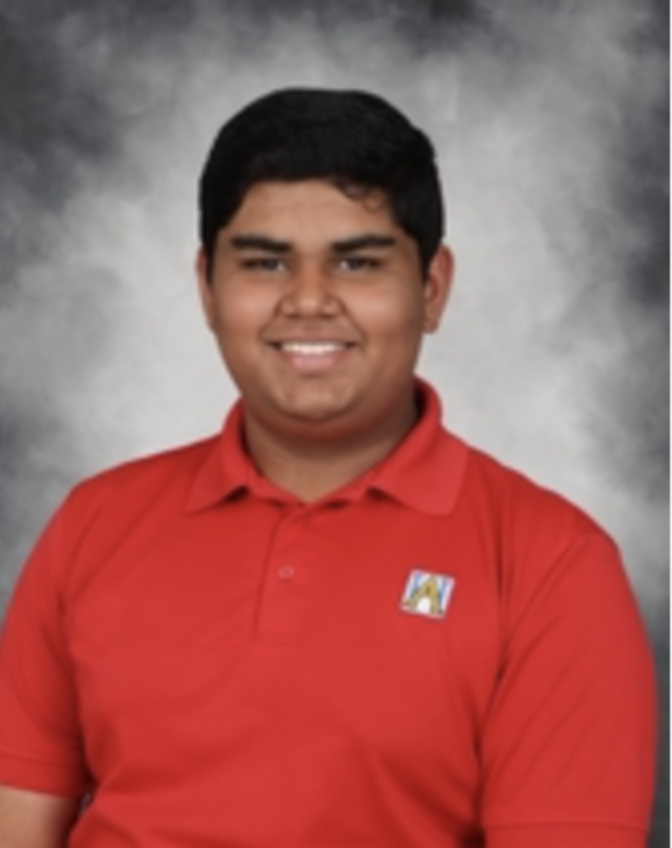
Biography
My name is Hamza Mairajuddin. I’m a junior. Outside of school I spend my time writing or watching movies. For my extracurriculars, I do DECA, YIS, and Speech and Debate.
What is your main source of inspiration?
My main source of inspiration is the people around me and older works from the greater writers in history.
What message do you hope to convey through your piece?
The message I want to convey for “Closing Remarks of a Star Born Soul” is that sometimes we need to be true to who we are, even if that means leaving everyone around us behind.